
Feeders & Fountains
Best Ceramic Cat Water Fountain: 4 That Cats Can't Tip Over (2026)
Contents17 sections
- Why Choose Ceramic Over Plastic or Stainless Steel?
- Does a Ceramic Fountain Look Better in a Kitchen?
- Are Ceramic Cat Fountains Harder to Clean?
- How Much Water Do You Actually Need?
- What Actually Breaks on a Ceramic Fountain?
- Best Ceramic Cat Water Fountains: Comparison Table
- iPettie Tritone Ceramic Cat Water Fountain — Best Overall
- Pioneer Pet Raindrop Ceramic — Cleanest Design
- PetSafe Drinkwell Pagoda — Two Drinking Heights
- Pioneer Pet Big Max — Largest Capacity
- What to Look for in a Ceramic Cat Water Fountain
- FAQ
- Are ceramic cat water fountains better than plastic ones?
- Can you put a ceramic cat fountain in the dishwasher?
- What size cat water fountain do I need?
- How often should you clean a ceramic cat fountain?
- Our Final Verdict
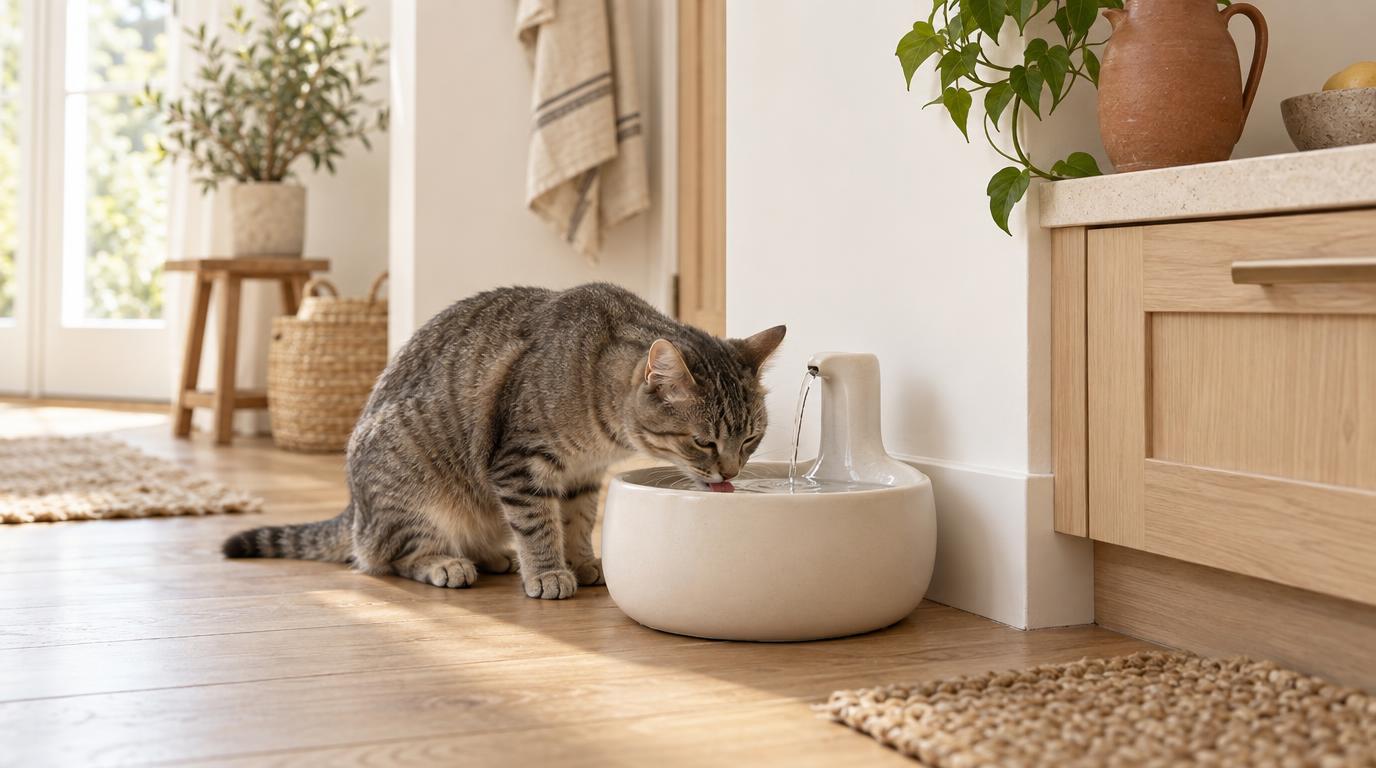
The best ceramic cat water fountain wins on weight before anything else. A ceramic bowl is too heavy and too slippery for a cat to shove across the floor, tip over or take apart, which is exactly what some cats do to lightweight plastic and steel models.
The looks are the second argument. Glazed ceramic sits beside your own dishes and mugs instead of announcing itself as pet equipment, which matters when the fountain lives in a kitchen or an open-plan room.
After comparing capacities, dishwasher-safe parts, pump specs, replacement costs and owner feedback across dozens of models, four ceramic fountains stand out. One is fully ceramic and nearly impossible to move, one is the cleanest-looking, one offers two drinking heights, and one holds a full gallon.
Why Choose Ceramic Over Plastic or Stainless Steel?
Ceramic’s real advantage is mass. A ceramic fountain full of water weighs enough that a determined cat can’t push it around, flip it, or lever the pieces apart, which is the failure mode owners report most often with light plastic fountains.
The material’s surface matters less than its weight. The PetSafe Drinkwell Pagoda weighs 7.05 lb empty, and a fully ceramic model like the iPettie Tritone adds 2.1 liters of water on top of that. Nothing a cat does with its paws moves that.
Plastic loses on finish too: it scratches and it holds odors, so a plastic bowl that’s a year old smells different from a new one even after washing. Glazed ceramic doesn’t take on that character.
If your cat is the type that paws at water, drags bowls across tile or has already dismantled one fountain, ceramic ends the game. For the wider comparison of materials and what picky cats actually choose, our guide to the best cat water fountain for picky drinkers covers steel and plastic too.
Does a Ceramic Fountain Look Better in a Kitchen?
Ceramic is the only fountain material that matches what’s already on your shelves. Your plates, mugs and serving bowls are glazed ceramic, so a fountain in the same finish reads as tableware rather than as an appliance.
Stainless steel is the premium choice on paper and the worse one visually in most homes. A steel bowl on a wooden floor looks like a piece of kitchen equipment; a matte white ceramic one looks like a planter.
Color options change the calculation too. PetSafe sells the Pagoda in four colors, so you can match a warm cream kitchen or a cooler gray one instead of accepting whatever finish the brand chose.
If your fountain has to live in an open-plan living room where guests see it, put the shape first. A rounded, seamless silhouette like the Pioneer Pet Raindrop disappears next to a plant pot, while a tiered design draws the eye and announces what it is. In a kitchen corner beside a cabinet leg, either works.
Are Ceramic Cat Fountains Harder to Clean?
Ceramic is the easiest fountain material to clean, because most models go straight into the dishwasher. Pioneer Pet describes its ceramic fountains as 100% dishwasher safe, and PetSafe asks for the Pagoda’s ceramic parts on the top rack with the pump washed by hand.
The bowl was never the hard part. The pump is, and that job is identical whether the fountain is ceramic, steel or plastic: Pioneer Pet recommends cleaning the fountain weekly, disassembling the pump monthly, and changing the filter every two to four weeks.
Ceramic does make one part of the routine heavier. A large glazed bowl is more awkward to lift into a sink than a plastic one, and a chip in the glaze from a knock against the tap doesn’t buff out.
If you tend to put off cleaning, pick a model with fewer pieces. The Pioneer Pet Raindrop is a two-piece construction, so a weekly wash means lifting out the pump and putting one bowl in the dishwasher, not reassembling a tower afterward.
How Much Water Do You Actually Need?
Most single-cat homes are well served by 60 to 70 oz, roughly 2 liters. Larger tanks exist for multi-cat households, and the Pioneer Pet Big Max goes to 128 oz, a full gallon.
The biggest fountain is the one you’ll refill least and clean least willingly. A full Big Max carries about 8 lb of water on top of an 8 lb ceramic body, so carrying it to the sink is a two-handed job rather than something you do while making coffee.
Tank size also decides how often the water turns over. A small bowl empties and gets refilled often, while a gallon of standing water in a quiet household sits there for days between top-ups.
If you have one cat and a small kitchen, a 60 oz Raindrop or a 2.1-liter Tritone hits the balance: refilling every couple of days, light enough to rinse at the sink without planning ahead. Buy the gallon version only if three or more cats share it, or if you travel for a day at a time and want the margin.
What Actually Breaks on a Ceramic Fountain?
The pump fails long before the ceramic does. Glazed ceramic survives years of daily use, while pumps are the moving part, running continuously and drawing in hair and grit.
That makes pump replacement more important than the bowl material. Pioneer Pet sells a universal pump compatible with most of its fountains, so a dead pump costs a part rather than a whole new fountain. iPettie rates the Tritone’s pump at around 10,000 hours of operation at about 2W.
Filters are the running cost nobody budgets for. At one filter every two to four weeks, a fountain quietly costs more over three years than its sticker price suggests, and that applies to every brand here.
Ceramic does have one failure mode plastic doesn’t: it cracks if dropped. If your fountain lives on a tile floor and gets washed in a deep sink, that’s a real risk, and it’s the one argument for steel we’d take seriously. On a wooden floor with a rubber mat underneath, we’d pick ceramic every time.
Best Ceramic Cat Water Fountains: Comparison Table
| Product | Price | Best For | Rating |
|---|---|---|---|
| iPettie Tritone Ceramic | ~$60 | Best overall | 4.5/5 |
| Pioneer Pet Raindrop Ceramic | ~$50 | Cleanest design | 4.4/5 |
| PetSafe Drinkwell Pagoda | ~$70 | Two drinking heights | 4.3/5 |
| Pioneer Pet Big Max | ~$90 | Multi-cat homes | 4.3/5 |
iPettie Tritone Ceramic Cat Water Fountain — Best Overall
Ceramic all the way through is what separates the Tritone from fountains that only use ceramic for the outer bowl. Its 2.1-liter body and cone are both glazed ceramic, with only the pump, filter and housing made from anything else, and it runs at roughly 2W with a pump rated for about 10,000 hours. A dual filtration setup pairs a foam filter around the pump with a carbon filter for odors.
If your cat treats water bowls as toys, this is the model that stops the game. Owner reviews repeatedly describe cats that dismantle plastic and stainless fountains giving up on this one, because the glazed body is too heavy and too slippery to get a grip on. It’s also quiet enough that the only sound is water dripping into the bowl.
Weight cuts both ways. A full ceramic fountain is heavier to lift into a sink than a plastic one, and it will chip if it meets a tap at speed. Replacement filters are specific to the Tritone and Fiumi models, so you’re buying into one brand’s consumables. The cone shape also means a cat drinks from the top stream or the bowl, so it covers both habits without a tiered design. For most homes, we’d still take it over any plastic fountain at twice the price.
Best for: Cats that tip, push or dismantle lighter fountains.
Pioneer Pet Raindrop Ceramic — Cleanest Design
Two pieces is the whole design. Pioneer Pet’s Raindrop is a 60 oz glazed ceramic fountain in a rounded teardrop shape that comes apart into bowl and pump, and the brand describes it as 100% dishwasher safe. It’s sold in white and black, and the same shape exists in stainless steel if you ever want to switch materials without changing the look.
If a fountain has to sit in plain sight on a kitchen floor or a hallway corner, this is the one that blends in. The curved silhouette reads as a ceramic planter rather than a pet product, and with only two parts, the weekly clean means lifting the pump out and putting one bowl in the dishwasher.
Simplicity costs you features. There’s no second drinking level, no water-level window, and 60 oz is modest if two or three cats share it. The filter needs changing every two to four weeks like every model here. Sharing its shape with Pioneer Pet’s stainless version is a quiet advantage, since the replacement pump and filters are the same parts either way. For a single cat in a home where the fountain is always visible, it’s the one we’d choose on looks alone.
Best for: Single-cat homes that want the fountain to disappear into the room.
PetSafe Drinkwell Pagoda — Two Drinking Heights
A raised upper bowl plus a lower reservoir gives this one something the others don’t. The Pagoda holds 70 oz, measures 10.63 x 12.25 x 8.38 inches, weighs 7.05 lb empty, and sends two free-falling streams from the top tier into the bowl below, so a cat can drink from either height. It ships with carbon and foam filters, and the ceramic parts go on the top rack of the dishwasher.
If you have two cats with different habits, or one that prefers drinking from a raised edge rather than floor level, the tiered layout covers both without buying two fountains. Four color options also make it easier to match an existing kitchen palette.
The tiered shape is the trade. It has more parts to separate at cleaning time than a two-piece fountain, its silhouette clearly reads as a pet fountain rather than as decor, and the falling water makes more noise than a still surface. Owner feedback keeps returning to the pump needing regular attention, which is true of the category but more noticeable on a design with two water paths. At 7.05 lb empty it’s still heavy enough that no cat is moving it, and the four colors give it a better chance of matching a kitchen than the single-finish models here.
Best for: Multi-cat homes where cats drink at different heights.
Pioneer Pet Big Max — Largest Capacity
A full gallon in glazed ceramic is a rare combination. Big Max holds 128 oz with an extra-large drinking area wide enough for several cats or a dog to use without crowding, and like the Raindrop it’s dishwasher safe, with a charcoal filter placed so water is filtered before it reaches the pump. The flow rate adjusts with a lever on the pump’s front panel.
If three cats share one water station, or you’re away for a full day and want the margin, this is the capacity that removes daily refilling from your routine. The wide bowl also suits cats that dislike their whiskers touching the sides of a narrow dish.
Size is the entire drawback. Full, it carries around 8 lb of water on top of an 8 lb ceramic body, so cleaning is a deliberate two-handed job, and the footprint is far larger than a 60 oz model in a small kitchen. Standing water also sits longer in a household that doesn’t drain it. The adjustable flow lever helps here, since a gallon pushed at full speed is louder than most kitchens want at night. For a single cat, we’d call this the wrong buy; for three, it’s the obvious one.
Best for: Multi-cat households that want to refill once or twice a week.
What to Look for in a Ceramic Cat Water Fountain
-
Check how much of it is actually ceramic. Some models pair a ceramic bowl with a plastic tower. Fully ceramic bodies, like the Tritone’s, are the heaviest and the hardest for a cat to move.
-
Count the pieces. Two-part designs go into the dishwasher and come back out in a minute. Tiered fountains take longer to disassemble, which decides whether you clean weekly or monthly.
-
Match capacity to your cats, not to the price. 60 to 70 oz suits one cat; 128 oz suits three or more. A larger tank means fewer refills and a heavier lift.
-
Look for replaceable pumps and easy filters. The pump fails before the ceramic does. Pioneer Pet’s universal pump fits most of its fountains, which turns a failure into a cheap part.
-
Budget for filters. One filter every two to four weeks is the standard across brands, and over three years it adds up to more than the fountain cost.
FAQ
Are ceramic cat water fountains better than plastic ones?
Ceramic fountains hold an advantage over plastic mainly through weight and finish: they’re heavy enough that cats can’t tip or dismantle them, and glazed surfaces don’t scratch or hold odors the way plastic does over time. Plastic is lighter and cheaper, and it won’t crack if dropped. Cleaning routines are the same for both.
Can you put a ceramic cat fountain in the dishwasher?
Most ceramic cat fountains are dishwasher safe, though the pump always needs hand washing. Pioneer Pet describes its ceramic fountains as 100% dishwasher safe, and PetSafe recommends the top rack for the Pagoda’s ceramic parts. Check the listing for your specific model before the first wash.
What size cat water fountain do I need?
A 60 to 70 oz fountain, roughly 2 liters, suits most single-cat homes and needs refilling every couple of days. Households with three or more cats are better served by a 128 oz model. Larger tanks mean fewer refills but a heavier lift at cleaning time.
How often should you clean a ceramic cat fountain?
Clean the fountain weekly, disassemble and clean the pump monthly, and replace the filter every two to four weeks, which is the routine Pioneer Pet recommends for its fountains. Ceramic makes the bowl easier because it goes in the dishwasher. The pump takes the same effort on any material.