
Feeders & Fountains
PETLIBRO vs Catit Cat Water Fountain: Which Brand Wins? (2026)
Contents17 sections
- What Does Each Brand Actually Sell You?
- Does the App Change Anything?
- Where Can You Actually Put It?
- What Will the Filters Cost You?
- Which One Looks Better in a Kitchen?
- PETLIBRO vs Catit: Comparison Table
- Catit Stainless Steel Flower Fountain — Best Value Overall
- PETLIBRO Dockstream Cordless — Best for Awkward Placement
- PETLIBRO Dockstream 2 — Most Connected
- Catit PIXI Smart Fountain — Catit’s Connected Option
- How to Choose Between PETLIBRO and Catit
- FAQ
- Is PETLIBRO or Catit better for cat water fountains?
- Does the Catit Flower Fountain hold more water than PETLIBRO?
- Do cat water fountain apps actually do anything useful?
- Which cat water fountain works without a power outlet nearby?
- Our Final Verdict
The PETLIBRO vs Catit cat water fountain question is really a question about how much hardware you want between your cat and a bowl of water. PETLIBRO builds apps, Wi-Fi and batteries into its fountains; Catit builds a pump, a filter and a lid, and charges a third of the price.
Capacity doesn’t follow price in this category. Catit’s 3-liter Flower Fountain holds exactly as much water as PETLIBRO’s flagship Dockstream 2, and Catit’s own smart model holds the least of the four.
After comparing capacities, materials, filter systems, power options and owner feedback across both ranges, the split comes down to three decisions: where the fountain has to sit, how much you’ll spend on filters over three years, and whether an app changes anything for you.
What Does Each Brand Actually Sell You?
PETLIBRO sells connected hardware and Catit sells a simple appliance. That difference shows up in every spec sheet: PETLIBRO lists Wi-Fi bands, app monitoring and battery life, while Catit lists reservoir size, flow settings and filter type.
The simplest fountain here holds the most water per dollar. The Catit Stainless Steel Flower Fountain carries 3 liters, matching the PETLIBRO Dockstream 2, with no app, no Wi-Fi and no battery in the box.
Design philosophy follows from that. Catit’s Flower Fountain has been sold in roughly the same shape for years, with a flower-shaped top and a visible water-level window, while PETLIBRO iterates models yearly and layers software on top.
If you want to know how much your cat drank last Tuesday, only one of these brands answers. If you want a fountain that runs for three years and gets rinsed on Sundays, the simpler one removes a whole category of things that can fail. Our guide to the best cat water fountain for picky drinkers covers which features actually change whether a cat drinks.
Does the App Change Anything?
An app tells you how often the fountain was used and when the water is low, and that’s the whole of it. The PETLIBRO Dockstream 2 connects over 5GHz Wi-Fi for monitoring; the Catit PIXI Smart Fountain uses Catit’s own PIXI app.
The smart fountain here is the smallest one. The PIXI Smart holds 2 liters against 2.5 on the standard PIXI and 3 on the Flower Fountain, so adding software cost Catit a third of its capacity.
Water-level alerts are the feature with real value. Everything else in these apps is a log you’ll check twice in the first week and then forget.
If you travel for work and someone else refills the fountain, a low-water notification on your phone is genuinely useful. If you walk past the fountain six times a day, a water-level window in the plastic does the same job for free, which is exactly what the Flower Fountain has.
Where Can You Actually Put It?
Power is what decides fountain placement, not design. Most fountains need a socket within cable reach, which rules out the middle of a room, a hallway corner or anywhere a cord would cross a walkway.
The battery model solves a problem the app never touches. The PETLIBRO Dockstream Cordless runs on a rechargeable battery with a 2.5-liter reservoir, so it can sit in a spot with no outlet nearby and get charged every few weeks.
Catit has no cordless equivalent. Every Catit fountain in this comparison needs mains power, though the PIXI range can run from a USB connection as well as a wall socket.
If your kitchen has one free socket and it’s behind the fridge, the cordless PETLIBRO is the only fountain here that fits the room you actually have. If your fountain will sit beside a side table with a socket behind it, that advantage disappears and you’re paying for a battery you don’t need.
What Will the Filters Cost You?
Filters are the recurring cost that decides which brand is cheaper over three years, and both sell them in multipacks. Catit’s Triple Action filters come in official 6-packs, and third-party replacements for the Flower Fountain and the PIXI are widely available in 6, 12 and 26-packs.
The cheaper fountain is also the cheaper one to feed. Catit’s filter format has been unchanged long enough that a competitive aftermarket exists, while PETLIBRO’s newer models use filters tied to specific units.
That matters more than the sticker price over a few years. A fountain bought once is a fountain fed with filters monthly.
Before buying either brand, search the filter by name and check how many sellers list it. A format with twenty sellers will still be cheap in two years; a format with one seller is a subscription with extra steps. We’d weigh that above any app feature in this category.
Which One Looks Better in a Kitchen?
Material is what decides this, and both brands offer steel on top of plastic reservoirs. The Catit Stainless Steel Flower Fountain pairs a steel top with its plastic base, and PETLIBRO’s Dockstream models use a stainless steel tray over a plastic body.
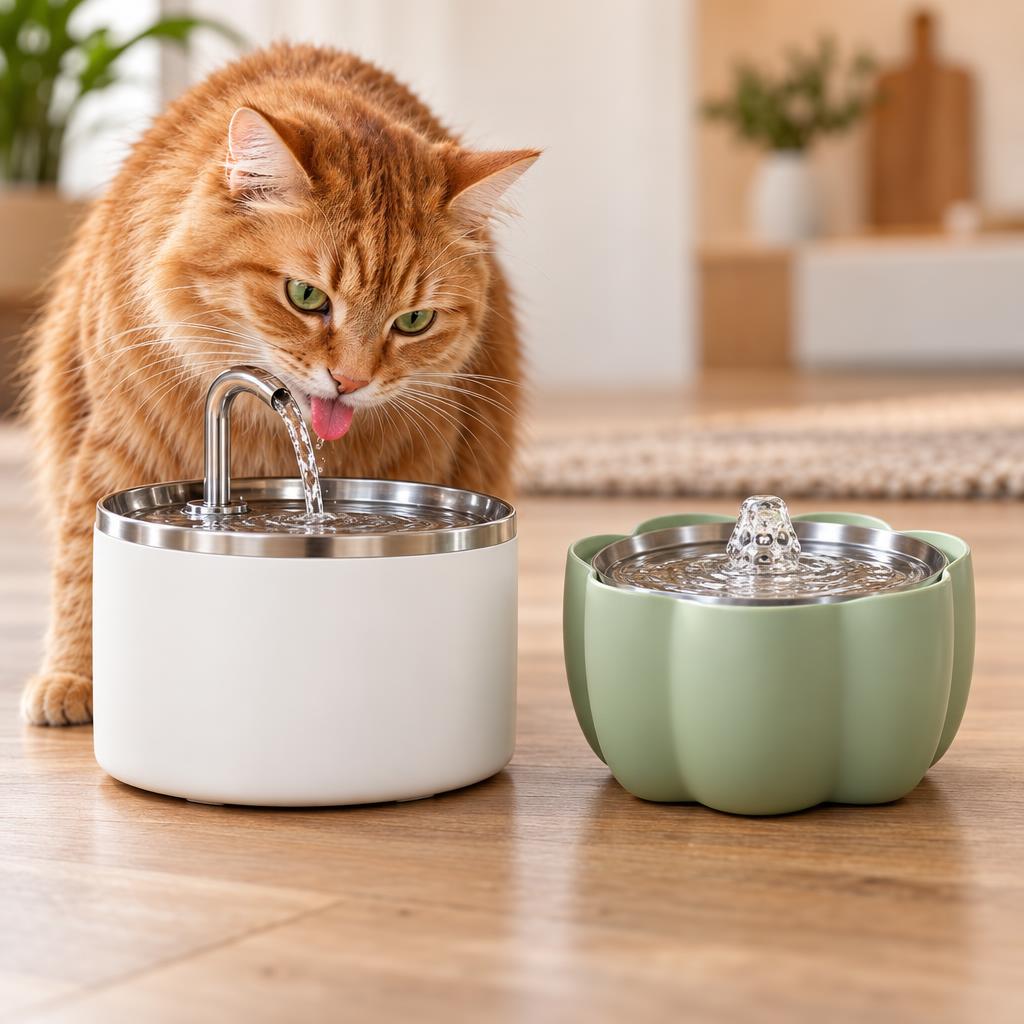
The fountain shaped like a flower is the one that hides better. Catit’s green-and-white original reads as a small plant pot from across a kitchen, while a steel tray on a white plastic cylinder reads as a gadget.
Footprint is close between them. The Flower Fountain measures 8.3 x 8.3 inches, compact enough for a corner beside a cabinet leg.
If your kitchen runs to warm wood and ceramics, a steel-topped fountain sits closer to your dishes than a white plastic one, and our guide to the best ceramic cat water fountain covers the material that blends in best of all. If the fountain lives in a utility room, buy on capacity and filters and ignore this section entirely.
PETLIBRO vs Catit: Comparison Table
| Product | Price | Best For | Rating |
|---|---|---|---|
| Catit Steel Flower Fountain | ~$40 | Best value | 4.5/5 |
| PETLIBRO Dockstream Cordless | ~$70 | No socket nearby | 4.3/5 |
| PETLIBRO Dockstream 2 | ~$90 | App monitoring | 4.4/5 |
| Catit PIXI Smart Fountain | ~$60 | Catit ecosystem | 4.2/5 |
Catit Stainless Steel Flower Fountain — Best Value Overall
Three liters for roughly a third of PETLIBRO’s flagship price is the argument, and it’s a strong one. The Flower Fountain holds 100 fl oz in a compact 8.3 x 8.3 x 7.3-inch body weighing 1.32 lb, combines a stainless steel top with a BPA-free plastic reservoir, and offers three flow settings plus a Triple Action filter. A water-level window on the reservoir shows when it needs refilling without opening anything.
If the fountain sits where you walk past it several times a day, that window does the job an app charges you for, and the flower-shaped top reads as decor rather than as pet equipment in a kitchen corner.
It has no battery, no app and no connectivity, so it must sit within cable reach of a socket. The plastic reservoir will scratch over years in a way steel doesn’t, and the green-and-white original clashes in a monochrome kitchen, though the steel-topped version tones it down. Three flow settings also let you dial the stream down to a trickle, which is the setting most owners end up on once the novelty wears off. Filters are the strongest practical argument, though: the format is old enough that multipacks are everywhere and cheap, which is not true of newer fountains from either brand.
Best for: Most homes, where capacity, price and filter availability matter more than software.
PETLIBRO Dockstream Cordless — Best for Awkward Placement
Running without a cable is a feature no Catit fountain offers. The Dockstream Cordless holds 2.5 liters (84 oz) behind a stainless steel tray, runs on a rechargeable battery, and signals on its display when the charge drops low. The steel drinking surface sits above a BPA-free plastic reservoir, and the whole unit is built to come apart for cleaning.
If the only sensible spot for a fountain is a hallway corner or an island with no socket behind it, this is the one that goes there. It also travels: a fountain you can move to a second floor without hunting for an outlet is more useful than one tethered to a wall.
Battery life means another maintenance task, since a fountain that stops when the charge runs out is worse than one that never stops. At 2.5 liters it holds less than the Flower Fountain while costing considerably more, and PETLIBRO’s filter formats are newer and tied to specific models, which narrows your buying options later. Charging means lifting the unit rather than plugging a cable into it, so plan on a spare few minutes every few weeks. We’d buy it only for the placement freedom, which is a real constraint in plenty of kitchens rather than a luxury.
Best for: Rooms where no socket sits within reach of the fountain’s spot.
PETLIBRO Dockstream 2 — Most Connected
Three liters with 5GHz Wi-Fi is PETLIBRO’s answer to everything Catit leaves out. The Dockstream 2 upgrades the original’s 2.5-liter reservoir to 3 liters (101 oz), keeps the stainless steel tray, and adds app monitoring that reports drinking activity and water level to your phone. The 5GHz band is unusual in pet hardware, where 2.4GHz is the norm, and it suits homes where the 2.4GHz band is already crowded.
If you leave a cat alone for a weekend and someone drops in to check on it, a low-water alert on your phone tells you whether that visit is urgent or routine, which is the one case where the connectivity does something a window in the plastic can’t.
Price is where it struggles against its own stablemate and against Catit. You pay a premium for monitoring while getting the same 3 liters the Flower Fountain provides for far less, and the app’s drinking logs are information rather than action. The plastic reservoir is the same material as the cheaper options. The 3-liter reservoir does mean fewer refills than the cordless model, which is the practical gain hiding behind the connectivity. For a connected household that genuinely uses the data, it’s the most capable fountain here.
Best for: Owners who travel and want water-level alerts on their phone.
Catit PIXI Smart Fountain — Catit’s Connected Option
Catit’s answer to PETLIBRO pairs an app with a UV-C clarifier lamp. The PIXI Smart holds 2 liters (67.5 fl oz), offers three drinking options through a calm flow, a spout stream and a bubbling top, and connects to the free Catit PIXI app for remote control of its features.
If you already own Catit feeders or planters and want one app across the setup, this keeps the ecosystem together rather than adding a second brand’s software to your phone.
Capacity is where the smart version loses. At 2 liters it holds a third less than the Flower Fountain and less than either PETLIBRO, so adding electronics cost Catit the one spec where its range was strongest. It’s also the newest format of the four here, which makes long-term filter and pump availability less certain than for the Flower Fountain. Three drinking options in one unit is a genuine advantage for a household where one cat prefers a stream and another prefers still water, since you can switch without buying a second fountain. The UV-C lamp is a feature of the unit rather than a reason to choose it. Buy it for the flow options and the app, not for the capacity.
Best for: Existing Catit owners who want one app across their cat gear.
How to Choose Between PETLIBRO and Catit
-
Start with the socket. If there’s no outlet near the fountain’s spot, the cordless PETLIBRO is the only option here. If there is, that advantage disappears.
-
Compare capacity against price, not against features. Catit’s Flower Fountain matches PETLIBRO’s flagship at 3 liters for a fraction of the cost, and Catit’s own smart model holds the least at 2 liters.
-
Check the filter supply before buying. Search the filter by name and count the sellers. Old formats like Catit’s Triple Action have cheap multipacks; newer model-specific filters don’t.
-
Decide whether you’ll use the app twice. A low-water alert helps if you travel. Drinking logs are a novelty for most households, and a water-level window does the same job for free.
-
Match the material to the room. Both brands pair steel tops with plastic reservoirs. The flower shape hides better in a kitchen; the steel cylinder reads as a gadget.
FAQ
Is PETLIBRO or Catit better for cat water fountains?
Catit is the better value for most households, since its 3-liter Flower Fountain matches PETLIBRO’s flagship capacity at a fraction of the price with a long-established filter supply. PETLIBRO wins on technology, offering app monitoring, Wi-Fi connectivity and the only cordless battery-powered model between the two brands. Choose PETLIBRO if placement or remote alerts matter, Catit if capacity and running costs do.
Does the Catit Flower Fountain hold more water than PETLIBRO?
The Catit Flower Fountain holds 3 liters (100 fl oz), matching the PETLIBRO Dockstream 2 and exceeding the 2.5-liter cordless Dockstream. Catit’s own PIXI Smart Fountain holds the least of the four at 2 liters. Capacity in this category does not track price.
Do cat water fountain apps actually do anything useful?
The genuinely useful app feature is a water-level alert, which tells you remotely when the reservoir is running low. Drinking-activity logs are informational rather than actionable for most households. Fountains with a visible water-level window, such as the Catit Flower Fountain, provide the same practical information without connectivity.
Which cat water fountain works without a power outlet nearby?
The PETLIBRO Dockstream Cordless is the only fountain between these two brands that runs on a rechargeable battery rather than requiring a nearby socket. It holds 2.5 liters and shows a low-charge warning on its display. Every Catit model in this comparison needs mains power, though PIXI fountains can also run from a USB connection.