
Buying Guides
How to Make a Small Apartment Cat-Friendly Without Clutter (2026)
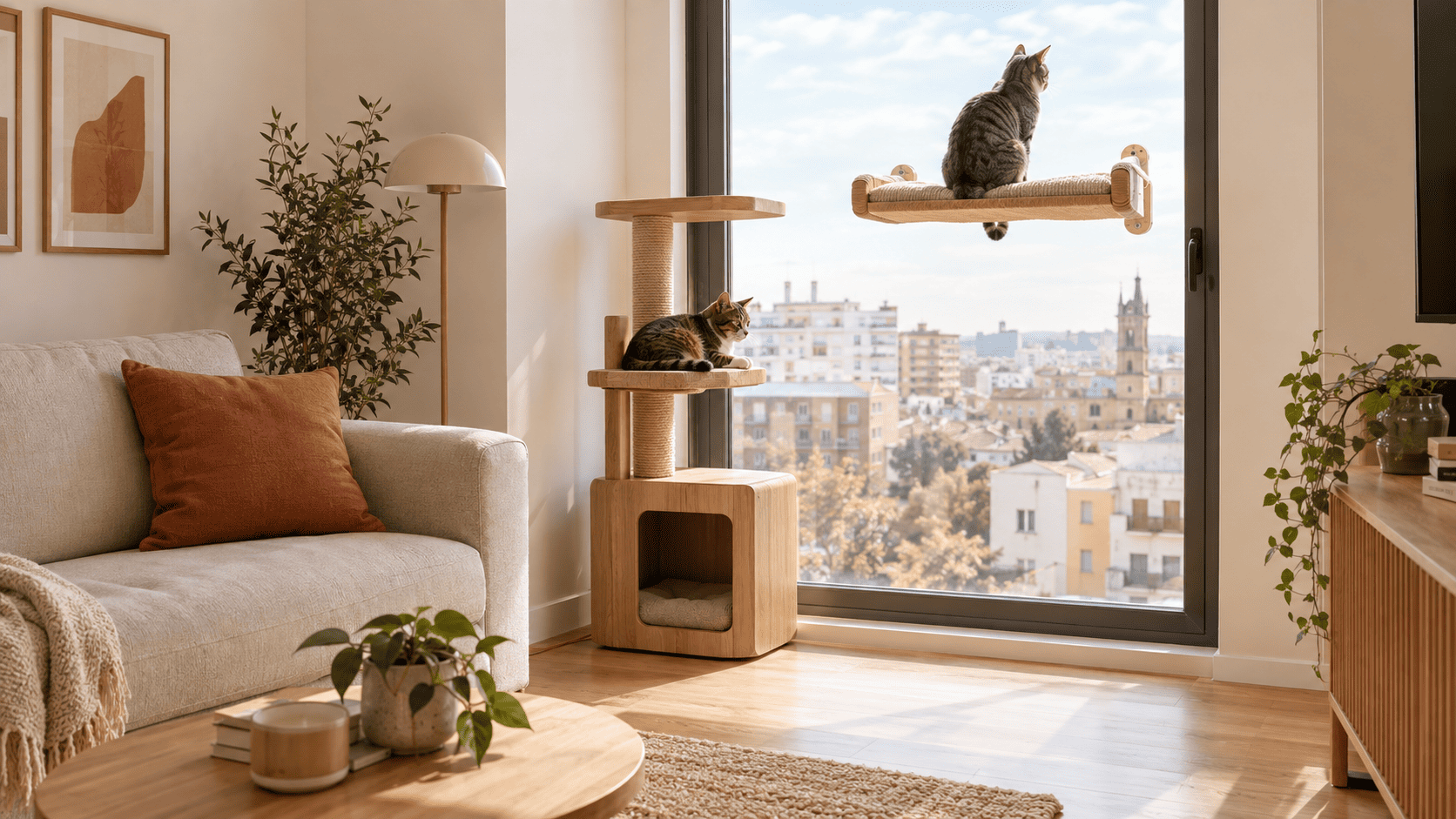
Contents17 sections
- What Does a Cat Actually Need in a Small Apartment?
- Why Does the Window Matter More Than Toys?
- Where Should the Litter Box Go in a Studio?
- How Do You Stop a Cat From Wrecking Small-Apartment Furniture?
- Does Cat Gear Make a Small Apartment Feel Smaller?
- Small-Apartment Cat Setup: Comparison Table
- Catit Vesper V-High Base — Best for Adding Height
- Solid Pine Cat Window Perch — Best Zero-Footprint Addition
- HOOBRO Litter Box Enclosure — Best Litter Box Solution
- PetFusion Ultimate Cat Scratch Lounge — Best Sofa Protection
- What to Prioritize When Setting Up a Small Apartment for a Cat
- FAQ
- Is a small apartment enough space for a cat?
- How much space does a cat tree need in a small apartment?
- Where do you put a litter box in a studio apartment?
- How do you stop a cat scratching the sofa in a small flat?
- Our Final Verdict
Knowing how to make a small apartment cat-friendly starts with a correction: the thing your cat is short of isn’t floor space. It’s height, a window, and somewhere the litter box can live without dominating the room.
Cats use a home in three dimensions while people use two. That’s why a 45-square-meter flat can feel generous to a cat and cramped to you, and why the fix is rarely “buy more stuff.”
After comparing footprints, mounting options, materials and owner feedback across dozens of pieces of cat furniture, four cover almost everything a small apartment needs. One adds height, one claims the window, one hides the litter box, and one protects your sofa.
What Does a Cat Actually Need in a Small Apartment?
A cat in a small apartment needs height, a window view, a litter box it can reach without crossing the whole flat, and a scratching surface near the furniture it already targets. Square meters barely enter into it.
Floor area is the measurement that matters least. A cat that can climb to 6 feet, nap on a windowsill and reach its box without passing a noisy appliance is using far more of a studio than a cat in a large flat where everything sits at ankle height.
That reframes the shopping list. Instead of asking what fits, ask what each piece adds: one route upward, one lookout, one bathroom, one place to scratch.
If your flat has a single main room, those four functions can occupy less than a square meter of floor combined, because two of them use walls and windows. The compact towers in our guide to cat trees for small apartments start at roughly 170 square inches of base, about the footprint of a stack of magazines.
Why Does the Window Matter More Than Toys?
A window is the single most-used feature in most cat households, and it costs nothing. Cats will spend hours tracking birds, weather and street movement from a sill they can actually fit on.
The cheapest upgrade in a small flat beats most of the expensive ones. A Solid Pine Cat Window Perch mounts on the glass itself and holds 42 lb without touching the floor, which no cat tree at any price can claim.
Sill depth is the usual obstacle. Modern apartment windows often have sills of 5 centimeters or less, which is a ledge rather than a seat, and a cat that can’t settle there stops trying after a few attempts.
If your only good window sits behind a radiator or a desk, a suction-mounted perch solves the geometry by putting a platform where the sill should have been. The manufacturer asks for 24 hours of curing time after mounting before a cat uses it, so plan the installation for an evening rather than expecting it to work immediately.
Where Should the Litter Box Go in a Studio?
In a studio, the litter box should go wherever it can stay accessible at all times, which usually rules out the bathroom. A box behind a door that gets closed at night is a box your cat can’t use for eight hours.
The bathroom is the default answer and often the wrong one. Small flats have exactly one bathroom, that door gets closed, and the room fills with steam and noise from a washing machine, all of which work against the one spot the box was supposed to occupy.
Furniture is what makes the alternative bearable. A HOOBRO Litter Box Enclosure puts the box inside a 31 x 17.5-inch bench at end-table height, so the living room keeps a side table rather than gaining a litter tray.
If your flat is genuinely one room, place the enclosure against the wall furthest from where the cat eats and sleeps, and check the depth against your walkway first. Cabinets in this category run from about 15.7 to 21.26 inches deep, and our guide to hidden litter box furniture covers which door style you’ll actually open every day.
How Do You Stop a Cat From Wrecking Small-Apartment Furniture?
You stop a cat scratching the sofa by putting a better surface immediately next to it, not by moving it away. Cats scratch in the places they already spend time, and a scratcher in a distant corner competes with furniture that’s right there.
Placement does more than any deterrent spray. A scratcher pushed against the exact corner your cat targets blocks that corner and offers an alternative in the same movement, which no repellent achieves.
Material decides whether the swap works. Corrugated cardboard, as on the PetFusion Ultimate Cat Scratch Lounge, is the surface most cats choose over sisal or wood, which is why the cheapest-looking option is usually the effective one.
In a small flat, that placement problem gets easier rather than harder: there are only so many corners, so you already know where the damage is happening. Pick the piece that can sit in the open without looking like pet gear, because in a studio there’s nowhere to hide it. At 34 inches long, the PetFusion lounge reads as a low bench next to a sofa rather than a pad on the floor.
Does Cat Gear Make a Small Apartment Feel Smaller?
Cat gear makes a small apartment feel smaller when it’s scattered, not when it’s large. Five small plastic items in five places create more visual noise than two well-chosen pieces of furniture.
Fewer, bigger objects read as tidier than many small ones. A single 31-inch bench that hides a litter box disappears into a room far better than a plastic tray, a scoop caddy and a mat arranged around it.
Material and color do the rest. Wood finishes, cream and warm neutrals blend into most apartments; bright plastic and light gray carpet announce themselves from the doorway.
If you’re furnishing from scratch, match each cat piece to the largest wooden item already in the room, whether that’s the floor, a table or a media console. A walnut-toned cabinet beside walnut furniture reads as intentional. And pick pieces that do two jobs where you can: a bench you can sit on, a lounger that works as a side table, a perch that replaces a missing sill. That’s how four cat-friendly functions fit into a flat without a single object looking out of place.
Small-Apartment Cat Setup: Comparison Table
| Product | Price | Best For | Rating |
|---|---|---|---|
| Catit Vesper V-High Base | ~$110 | Adding height | 4.6/5 |
| Solid Pine Cat Window Perch | ~$50 | Zero floor space | 4.4/5 |
| HOOBRO Litter Box Enclosure | ~$110 | Hiding the box | 4.5/5 |
| PetFusion Ultimate Cat Scratch Lounge | ~$70 | Sofa protection | 4.6/5 |
Catit Vesper V-High Base — Best for Adding Height
Twenty-two inches square is the whole argument for this one. Catit’s V-High Base measures 22 x 22 x 32 inches, roughly the floor space of a small side table, and stacks a hideout cube and raised platforms into oak-finish panels that read as modern furniture rather than carpeted pet gear. It assembles without tools, and Catit says the surfaces don’t attract cat hair the way carpet does.
If the only free spot in your flat is the 60-centimeter gap between a sofa and a window, this fits it. More usefully, its top platform sits at sofa-back height, so a cat can step from tree to sofa to bookshelf and treat three pieces of furniture as one continuous route upward. In a studio, that chain matters more than the height of any single object.
Thirty-two inches is short for a dedicated climber, so a cat that wants to be above your head will keep using the wardrobe. It costs around $110, more than many taller carpeted trees, and the square footprint needs a clear wall rather than a tight corner. We’d still pay it, because Catit sells replacement cushions and posts, and a tree you can repair outlasts two you replace.
Best for: Small living rooms that need one good-looking piece to start the climb.
Solid Pine Cat Window Perch — Best Zero-Footprint Addition
Mounting on the glass means this costs you no floor at all. The perch is built from real pine with thick cotton ropes and a cushion, and its industrial-grade suction cups are rated to hold 42 lb, which covers any domestic cat with a wide margin. The wood-and-rope construction sits closer to a hanging plant holder than to the plastic-and-mesh hammocks that dominate this category.
If your apartment’s best window has a sill too shallow for a cat to sit on, this is the piece that fixes it without rearranging a single item of furniture. It works particularly well in a studio where the window is already the visual focus of the room, since a pine seat reads as part of the decor rather than an attachment.
Installation demands patience: the manufacturer specifies 24 hours of curing time after mounting before a cat uses it, and both the glass and the cups need cleaning first. Suction mounts also need periodic re-checking, and the perch blocks the lower part of the window, which matters if that’s the one you open. Pine is also heavier than the plastic-frame hammocks it competes with, which is exactly why the cups need checking. Mount it on a window you don’t open daily and it earns its place several times over.
Best for: Flats with a good view and a windowsill too narrow to sit on.
HOOBRO Litter Box Enclosure — Best Litter Box Solution
Turning the litter box into a side table is the point of this one. HOOBRO’s bench measures 31 x 17.5 x 19.7 inches, takes a static load of 220 lb on top, and includes a removable divider so you can split the interior between the box and litter storage or take it out for a larger tray.
If your flat has no room where a plain litter box would go unnoticed, this puts it in the living room as a piece of furniture instead. The 220 lb top rating means it genuinely functions as a surface, so a lamp, a plant or a stack of books can live there, which is what stops it reading as pet equipment. White, greige, walnut and rustic brown cover most common floor tones.
Pressed wood is the compromise at this price: it won’t age like solid oak, and the interior wants wiping rather than washing. The front-door design also means crouching to scoop, which is the one thing top-opening cabinets do better. Assembly is a flat-pack job from a 36 x 20.7-inch box, so clear an evening and a bit of floor. For a studio where the box has nowhere private to go, we’d still take it over any covered plastic tray on the market.
Best for: Studios and one-bedrooms with no discreet spot for a litter box.
PetFusion Ultimate Cat Scratch Lounge — Best Sofa Protection
Thirty-four inches of curved corrugated cardboard is what stands between your sofa and a determined cat. The PetFusion lounge measures 34 x 10.5 x 10.5 inches, enough for a large cat to stretch out on, and comes in walnut brown and cloud white rather than pet-store brights. It’s reversible, so you flip it when one side wears down.
Placed directly against the sofa arm your cat already works over, it blocks that corner and offers the material most cats prefer in the same move. The curve gives both a flat surface and an angled one, and at bench height it passes as low furniture in a room where there’s nowhere to hide it.
Cardboard sheds, and this is a lot of cardboard, so expect crumbs daily, which is more visible on dark floors than on a rug. At 34 inches long it’s also a real presence in a small room, and the cream version shows dirt faster than the walnut. At around $70 it costs several times a basic pad. We’d still buy it once rather than three cheap ones that end up ignored, and PetFusion glues its boards individually rather than using pre-glued blocks, which is the detail that separates a scratcher lasting years from one collapsing in months.
Best for: Small flats where the sofa is the cat’s current scratching post.
What to Prioritize When Setting Up a Small Apartment for a Cat
-
Buy height before floor furniture. A route upward using walls, windows and existing furniture adds more usable space than anything that sits on the ground.
-
Claim the best window first. Measure the sill: under about 5 centimeters and a cat can’t settle there, which makes a mounted perch the highest-value single purchase in the flat.
-
Place the litter box somewhere permanently accessible. Avoid rooms with doors that get closed, and check cabinet depth against your walkways before buying.
-
Put the scratcher where the damage is. Against the sofa corner your cat already uses, not in a tidy corner across the room.
-
Choose fewer, larger, dual-purpose pieces. A bench that hides a box or a lounger that works as a side table keeps a small room from filling with small objects.
FAQ
Is a small apartment enough space for a cat?
Yes, a small apartment suits most cats well, because cats use vertical space and sightlines more than floor area. A studio with a climbable route, a window perch and an accessible litter box gives a cat more usable territory than a large flat where everything sits at floor level. Layout matters more than square meters.
How much space does a cat tree need in a small apartment?
A cat tree for a small apartment needs about 22 x 22 inches of floor or less, roughly the footprint of a small side table. Floor-to-ceiling models with tension poles use bases closer to 17 x 10 inches. Measure the exact spot before buying, since depth is what blocks walkways.
Where do you put a litter box in a studio apartment?
Put the litter box somewhere your cat can reach at any hour, which usually means the living area rather than a bathroom whose door gets closed. Place it away from where the cat eats and sleeps, and use a furniture-style enclosure if the box will be visible. Check the cabinet’s depth against your walkway.
How do you stop a cat scratching the sofa in a small flat?
Put a scratcher directly against the part of the sofa your cat already targets, using a material cats prefer such as corrugated cardboard. Cats scratch where they spend time, so distance defeats any alternative surface. Once the new surface is in regular use, you can move it a little at a time.