
Cat Furniture
Best Cat Trees for Small Apartments That Don't Eat Your Floor (2026)
Contents17 sections
- How Much Floor Space Does a Cat Tree Need in a Small Apartment?
- Where Should a Cat Tree Go in a Small Apartment?
- Is a Short Cat Tree Enough, or Do Cats Need a Tall One?
- Which Cat Tree Materials Look Best in a Small Space?
- Are Floor-to-Ceiling Cat Trees Good for Renters?
- Best Cat Trees for Small Apartments: Comparison Table
- Catit Vesper V-High Base — Best Overall
- PETEPELA Floor to Ceiling Cat Tree — Best for Tiny Footprints
- Feandrea Modern Cat Tree — Best Budget
- CatastrophiCreations Solid Wood Cat Shelf — Best Wall-Mounted Alternative
- What to Look for When Choosing a Cat Tree for a Small Apartment
- FAQ
- What size cat tree is best for a small apartment?
- Do floor-to-ceiling cat trees require drilling?
- Where should you put a cat tree in a small apartment?
- How do you make a cat tree look good in a small living room?
- Our Final Verdict
The best cat trees for small apartments take up no more floor than a side table, or they use your ceiling height instead of your floor. For most homes that means a compact modern tree like the Catit Vesper V-High Base, which fits in 22 x 22 inches and looks like furniture.
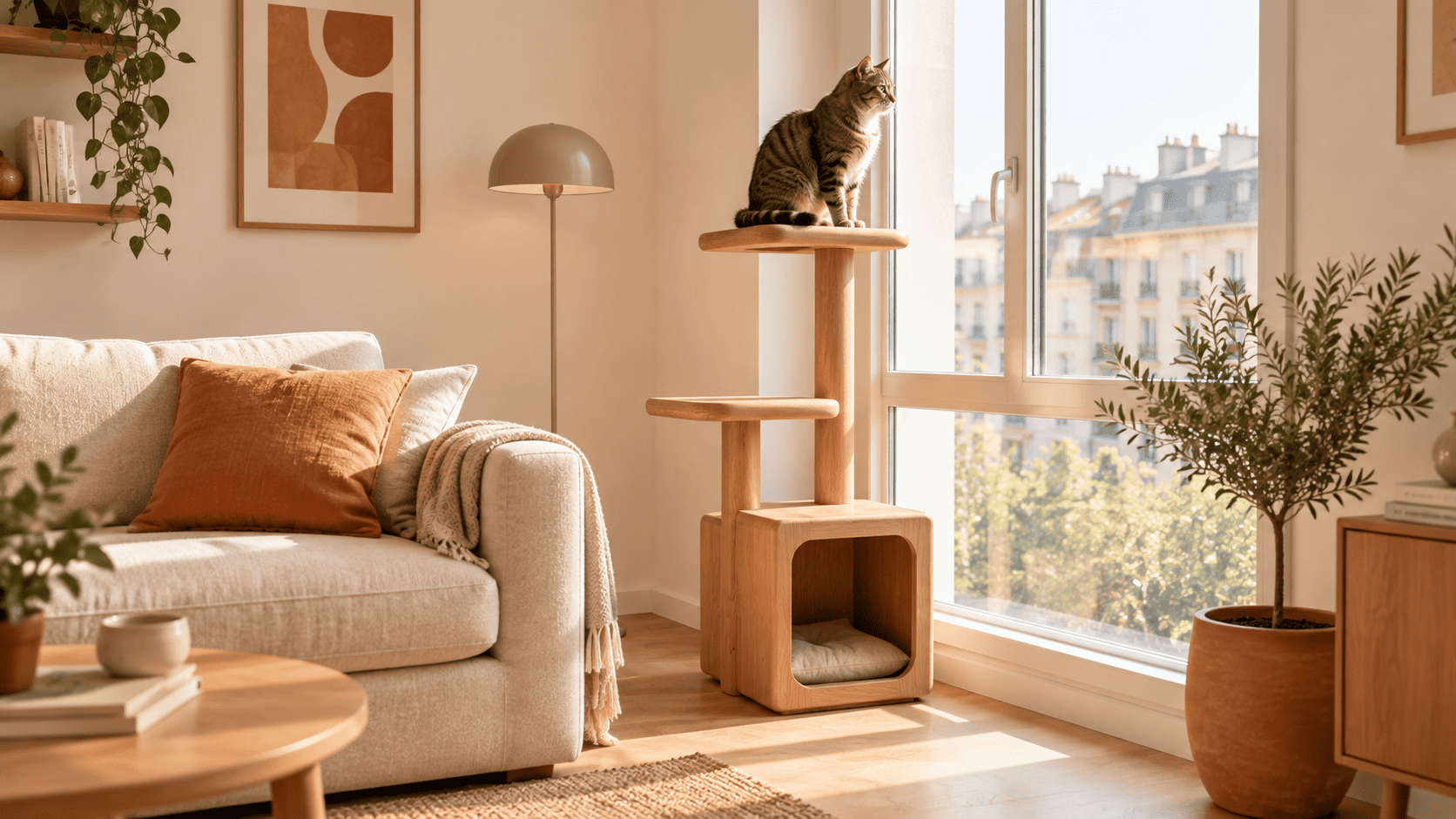
A cat tree in a small apartment can’t hide in a spare room. It ends up in the living room, next to the sofa and the window, where it either blends in or becomes the ugliest thing you own.
After comparing footprints, ceiling ranges, materials and owner feedback on more than 20 cat trees and wall perches, these four stand out. One suits a stylish living room, one a tiny studio corner, one a tight budget, and one uses no floor at all.
How Much Floor Space Does a Cat Tree Need in a Small Apartment?
A cat tree for a small apartment should take up no more floor than a small side table, roughly 22 x 22 inches or less. Footprint, not height, decides whether a tree fits.
The tallest tree in this guide has the smallest base. The PETEPELA Floor to Ceiling Cat Tree reaches up to 107 inches on a 17.3 x 9.8-inch base, about 170 square inches of floor. The 32-inch Catit Vesper V-High Base covers 22 x 22 inches, or 484 square inches, nearly three times as much.
Height is free in an apartment and floor isn’t. Most rooms have several feet of empty vertical space above the furniture, while every square foot of floor already competes with a sofa, a desk or a drying rack.
If your studio’s only open spot is the corner between a radiator and a window, measure it before you open a single product page. A tree that is 6 inches too wide ends up blocking a walkway, and a tree that blocks a walkway usually gets moved to the bedroom, far from where your cat wants to be.
Where Should a Cat Tree Go in a Small Apartment?
The best place for a cat tree in a small apartment is beside a window, in the room where people spend the most time. Cats tend to pick perches that let them watch both the outdoors and the household.
A small tree in the busiest room usually gets more use than a big tree in the quietest corner. Hiding the tree in a spare room to protect the living room’s look often means paying for furniture the cat ignores.
That’s why compact, good-looking designs matter so much in small homes: the tree has to live where it’s visible. The Catit Vesper V-High Base and the walnut-color Feandrea Modern Cat Tree are built for exactly that, sitting in a living room without looking like a pet-store display.
If your apartment has one large window in the main room, put the tree beside it and turn the top platform toward the glass. In a studio, the gap between the sofa and the window often works best, because the sofa back becomes an extra step up.
Is a Short Cat Tree Enough, or Do Cats Need a Tall One?
A short cat tree is enough in many small apartments, as long as it connects to other surfaces a cat can reach. Height relative to the room matters more than the number on the box.
A 32-inch tree beside a sofa can do the job of a 5-foot tower. A cat that jumps from the top platform to the sofa back and then to a bookshelf is following a route, and the tree is just the first step.
That changes the math in a small apartment. Instead of one tall tower that dominates a wall, you can place a compact tree like the Catit Vesper V-High Base where it meets furniture you already own, then add a wall perch such as the CatastrophiCreations Solid Wood Cat Shelf above it later.
If your cat already hangs out on top of the fridge or the wardrobe, it prefers real height, and a floor-to-ceiling pole deserves a look. If it naps on the sofa arm and watches the window, a sub-40-inch tree like the Feandrea Modern Cat Tree covers it in a fraction of the space.
Which Cat Tree Materials Look Best in a Small Space?
Smooth wood and wood-finish panels look best in a small space, because they read as furniture and don’t hold onto cat hair. Carpet and plush are what make most cat trees look like pet-store gear.
The coziest-looking materials make a small room look messier. Carpet and plush trap shed hair and dust in their fibers, so a light gray carpet tree shows every bit of it, while a smooth panel comes clean with a wipe.
Catit says its Vesper surfaces don’t attract cat hair, and it sells replacement cushions and scratching posts to extend the life of the frame. Any cushioned perch, including the one on the Feandrea Modern Cat Tree, will still need a lint roller now and then.
Pick a finish close to your cat’s coat. A dark walnut tone hides a black cat’s fur, while light oak like the Catit Vesper V-High Base hides a cream or white coat. Beyond that, match the tree to the largest wooden piece in the room, whether that’s the floor, a dining table or a media console, and it will look planned instead of added.
Are Floor-to-Ceiling Cat Trees Good for Renters?
Floor-to-ceiling cat trees are one of the best vertical options for renters, because they hold themselves in place with a tension rod instead of screws. That puts them ahead of wall shelves for anyone whose lease forbids drilling.
A ceiling-high pole can be more rental-friendly than a single small shelf. The PETEPELA Floor to Ceiling Cat Tree presses against the ceiling, while a wall perch like the CatastrophiCreations Solid Wood Cat Shelf needs screws, ideally into studs.
The trade-off is precision. Tension poles only work within their listed height range, and the PETEPELA adjusts from 95 to 107 inches. A standard 8-foot ceiling (96 inches) fits; a 9-foot ceiling (108 inches) sits just outside it.
If your apartment has sloped, beamed or textured popcorn ceilings, we’d skip floor-to-ceiling trees entirely, since a tension rod needs a flat, solid surface to press against. A compact floor tree plus one wall shelf, where drilling is allowed, gets you most of the same height.
Best Cat Trees for Small Apartments: Comparison Table
| Product | Price | Best For | Rating |
|---|---|---|---|
| Catit Vesper V-High Base | ~$110 | Best overall | 4.6/5 |
| PETEPELA Floor to Ceiling Cat Tree | ~$90 | Tiny footprints | 4.3/5 |
| Feandrea Modern Cat Tree | ~$65 | Tight budgets | 4.4/5 |
| CatastrophiCreations Solid Wood Cat Shelf | ~$60 | Zero floor space | 4.5/5 |
Catit Vesper V-High Base — Best Overall
Catit’s Vesper V-High Base is the cat tree to buy if it has to live in your living room. It measures 22 x 22 x 32 inches, about the floor space of a small side table, and its oak-finish panels, hideout cube and raised platforms look like modern furniture rather than pet-store carpet. Catit designs the Vesper line to assemble without tools and says its surfaces don’t attract cat hair the way carpeted trees do.
If you have a 24-inch gap between the sofa and a window, the V-High Base fits it with room to spare. A cat can step from the top platform onto the sofa back or the sill, which makes a 32-inch tree part of a much longer route around the room. The oak finish sits naturally beside light Scandinavian wood, white walls and linen upholstery, and the square footprint lines up cleanly against a wall.
Height is the real limitation. At 32 inches this is a lounging and lookout tree, not a climbing tower, so a cat that wants to be above your head will head for the bookshelf instead. It also costs around $110, more than many taller carpeted trees. We’d still pay it: Catit sells replacement cushions and scratching posts, so worn parts get swapped instead of the whole tree ending up on the curb.
Best for: Small living rooms where the cat tree has to pass as furniture.
PETEPELA Floor to Ceiling Cat Tree — Best for Tiny Footprints
The tallest cat tree on this list has the smallest base. The PETEPELA Floor to Ceiling Cat Tree adjusts from 95 to 107 inches tall, stands on just 17.3 x 9.8 inches of floor and stays upright with a tension rod at the top. Its 5 platforms are spaced 17.3 inches apart, and the whole tower weighs 8.7 kg (19.18 lb), light enough for one person to move to another room.
If you live in a studio with standard 8-foot ceilings, that’s 96 inches, right inside the adjustment range. Tucked into the corner beside a window, the pole gives a cat five lookout points stacked vertically in a spot about as wide as a floor lamp base. The beige finish also keeps it visually quieter than the dark gray carpet towers that fill this category, which matters when the tree is the first thing you see from the front door.
Where it falls short is capacity and lounging space. PETEPELA recommends it for kittens and small to medium cats and notes that cats over 20 lb may be too heavy for the top scratching post. Pole-style platforms are built for perching, so a cat that wants a long, stretched-out nap will still choose the sofa. Measure before ordering: a 9-foot ceiling is 108 inches, just past the listed range, and the rod needs a flat, solid ceiling to press against.
Best for: Studios and rentals where floor space is the scarcest thing you have.
Feandrea Modern Cat Tree — Best Budget
Budget cat trees are mostly gray plush, which is why the Feandrea Modern Cat Tree in walnut color stands out at around $65. At 37.8 inches tall, it combines a cave, a basket lounger and a top viewing perch with scratching posts in one compact frame, and the dark wood tone reads as furniture from across a small room.
If your one-bedroom only has space for a single piece of cat furniture, this one covers three jobs: hiding, napping and watching. Against a wall next to a bookshelf or a walnut media console, the finish blends in, where a light gray carpet tree would stand out as the one pet-store object in the room. For a cat that likes both a covered spot and a high one, you get both without buying a separate bed, and the whole thing stays under 40 inches, low enough to sit beneath most wall-mounted shelves.
What you give up at this price is finish quality. Walnut here is a color finish rather than solid hardwood, so it won’t age like real wood furniture, and the cushioned perch and basket hold onto hair that a smooth Vesper panel wouldn’t. Under 40 inches is also a modest height for dedicated climbers. For the money, we’d still take it over any carpeted tree at the same price.
Best for: Budget-minded owners who want a tree and a cat bed in one wood-toned piece.
CatastrophiCreations Solid Wood Cat Shelf — Best Wall-Mounted Alternative
Sometimes the best cat tree for a small apartment isn’t a tree at all. The CatastrophiCreations Solid Wood Cat Shelf is an 18-inch handcrafted shelf in English Chestnut that mounts to the wall, putting a perch at whatever height you choose while using zero floor space. Solid wood gives it the look of a floating bookshelf rather than cat gear.
If your apartment already has a compact tree or a sofa near a window, one or two of these shelves above it turn the wall into the next level of the climb. Owner reviews mention shelves holding a 16 lb cat and a 20 lb cat without trouble, and some owners describe adding more pieces over time to extend the route. The chestnut finish pairs especially well with warm mid-century rooms and dark wood floors.
Installation is the dealbreaker for renters. A wall shelf has to be screwed into the wall, ideally into studs, and a single 18-inch shelf is one perch, not a full setup, so most apartments need two or three to create a real route. The cost per perch adds up quickly once you buy several. If your lease forbids drilling, the floor-to-ceiling PETEPELA is the vertical option to choose instead.
Best for: Owners who can drill and want vertical space without giving up any floor.
What to Look for When Choosing a Cat Tree for a Small Apartment
-
Measure the footprint, not the height. Mark the exact spot on the floor with tape before buying. A base around 22 x 22 inches or smaller fits most small living rooms, and pole-style trees can go down to about 17 x 10 inches.
-
Check your ceiling or wall first. Floor-to-ceiling trees only work within their listed height range and need a flat ceiling. Wall shelves need drilling, ideally into studs, which many leases don’t allow.
-
Choose surfaces you can wipe clean. Smooth wood and wood-finish panels stay tidy with a cloth, while carpet and plush hold onto shed hair. In a small room, that difference is visible every day.
-
Match the finish to your room and your cat. Pick a tone close to your largest wooden furniture, and lean lighter or darker depending on your cat’s coat color so shed hair shows less.
-
Read the manufacturer’s size guidance. Some compact designs are rated for smaller cats; the PETEPELA notes that cats over 20 lb may be too heavy for its top post. Check the listing before choosing a tree for a large cat.
FAQ
What size cat tree is best for a small apartment?
The best cat tree for a small apartment has a base no larger than about 22 x 22 inches, roughly the footprint of a small side table. If floor space is even tighter, a floor-to-ceiling pole with a base around 17 x 10 inches uses vertical space instead. Measure the exact spot before choosing a model.
Do floor-to-ceiling cat trees require drilling?
Most floor-to-ceiling cat trees don’t require drilling, because a tension rod at the top holds the pole between the floor and the ceiling. They only work within a listed height range, such as 95 to 107 inches for the PETEPELA model, so measure your ceiling first. Sloped or textured ceilings are a poor match.
Where should you put a cat tree in a small apartment?
The best spot for a cat tree in a small apartment is beside a window in the room where you spend the most time. Cats tend to favor perches with a view of both the outdoors and the household. A tree next to the sofa can also use the sofa back as an extra step.
How do you make a cat tree look good in a small living room?
A cat tree looks best in a small living room when it uses smooth wood or wood-finish panels instead of carpet and matches the largest wooden piece in the room. Compact modern designs like the Catit Vesper line read as furniture rather than pet gear. A finish close to your cat’s coat color also keeps shed hair less visible.