
Beds & Scratchers
Best Cat Scratcher That Looks Good in a Real Living Room (2026)
Contents17 sections
- Why Do Good-Looking Cat Scratchers End Up Unused?
- Cardboard, Sisal or Wood: Which Material Do Cats Actually Prefer?
- How Tall Does a Vertical Cat Scratcher Need to Be?
- Which Scratchers Make the Least Mess?
- Are Wall-Mounted Scratchers Worth It?
- Best Cat Scratchers That Look Good: Comparison Table
- PetFusion Ultimate Cat Scratch Lounge — Best Overall
- FUKUMARU Modern Square Post — Best Wooden Design
- PetFusion 3-Sided Vertical Scratcher — Best for Upward Scratchers
- FUKUMARU Wall Mounted Scratching Post — Best for Zero Floor Space
- What to Look for in a Cat Scratcher That Looks Good
- FAQ
- What kind of scratcher do cats like best?
- Where should you put a cat scratcher?
- Should a cat scratcher be horizontal or vertical?
- How long does a cardboard cat scratcher last?
- Our Final Verdict
The best cat scratcher that looks good is the one your cat destroys, not the one that stays pristine on a shelf. A scratcher still looking new after a year is furniture your cat has quietly refused.
That’s the tension in this whole category. Anything discreet enough to sit beside a sofa usually gets pushed into a corner, and a corner is exactly where cats ignore things.
After comparing materials, dimensions, replaceable parts and owner feedback on more than 20 scratchers, four stand out for homes where the thing has to live in plain sight. One is a curved cardboard lounge in neutral tones, one a solid wood post, one a vertical cardboard tower, and one mounts on the wall and uses no floor at all.
Why Do Good-Looking Cat Scratchers End Up Unused?
Good-looking scratchers go unused because owners put them where they look best, not where the cat scratches. Cats scratch near where they sleep and where people gather, which is usually the middle of a room, not a tidy corner.
Choosing an attractive scratcher makes this worse, not better. The nicer it looks, the more tempting it is to stage it like decor, and a scratcher styled into a corner beside a plant competes with a sofa arm that sits right where your cat wakes up.
Placement beats design every time. Put the scratcher directly next to the furniture your cat already targets, and once it’s genuinely in use you can move it a foot or two at a time.
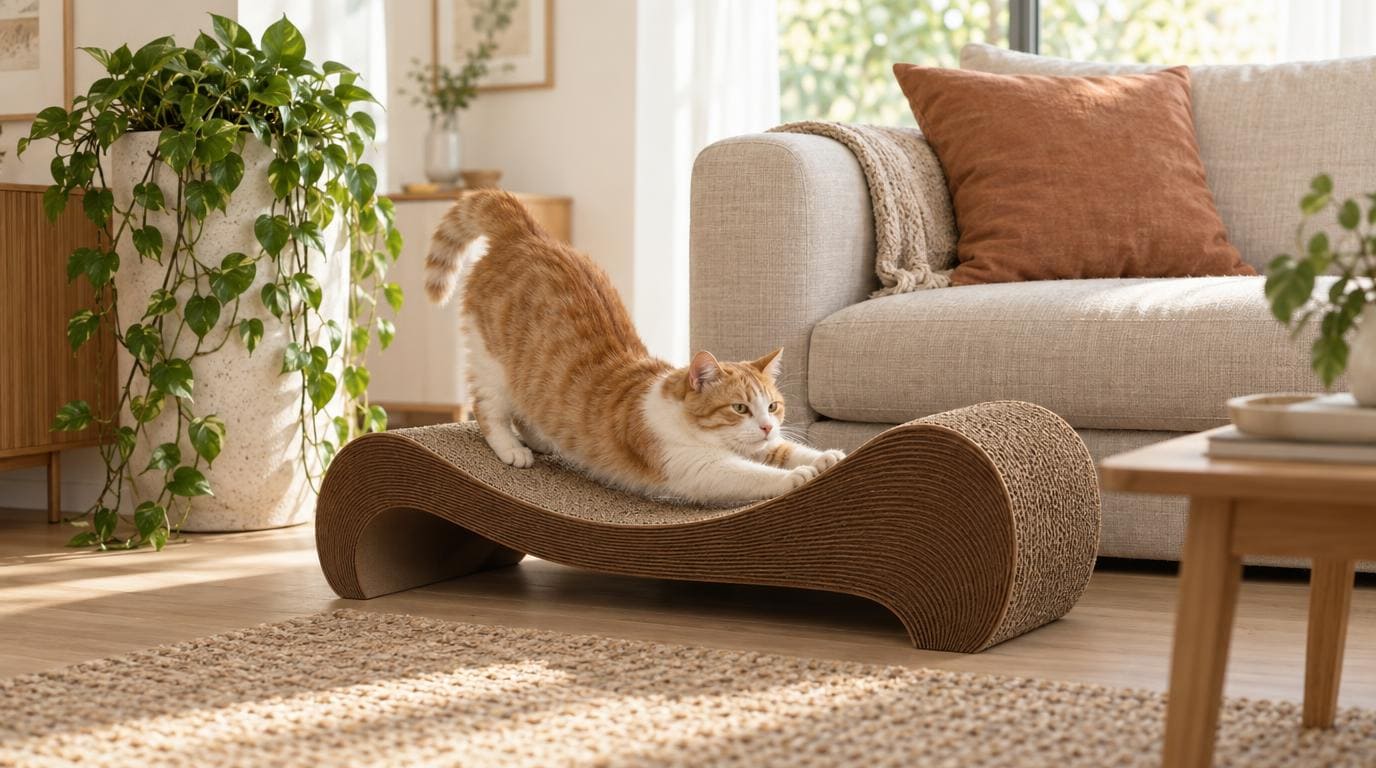
If your cat works over the corner of the couch each morning, that’s the spot. A 34-inch cardboard lounge like the PetFusion Ultimate Cat Scratch Lounge parked against that arm blocks the couch and offers a better surface in the same motion. It also explains why we’d pick a scratcher that doubles as a low bench or a side table: something that belongs in the middle of a room won’t get exiled to the edge of it. The same logic drives the better hidden litter box furniture, which earns its spot by working as an end table first.
Cardboard, Sisal or Wood: Which Material Do Cats Actually Prefer?
Corrugated cardboard is the material most cats choose, even though it’s the cheapest-looking of the three. The exposed edge grain gives claws something to sink into and shred, which is closer to bark than a smooth wound rope.
The premium material is often the one gathering dust. A solid wood post can look far better in a living room and still lose to a $35 cardboard pad, while sisal sits in between: more durable, less satisfying to shred, and it holds its shape for years.
Durability runs opposite to preference here. Cardboard wears fastest precisely because it gets used most, which is why reversible designs matter. PetFusion builds its lounge to flip over for a second full surface, and FUKUMARU wraps posts in natural sisal that can be turned when one side wears down.
If you want one scratcher to last, buy sisal or wood and accept that some cats will keep going for the couch. If you want the one your cat uses daily, buy cardboard and plan on replacing it. A scratcher that looks untouched after twelve months isn’t durable; it’s rejected.
How Tall Does a Vertical Cat Scratcher Need to Be?
A vertical scratcher should let an adult cat reach up with its front paws while standing on its back legs, which for most cats means around 30 inches of usable scratching surface. Many posts marketed as tall fall short of that.
Height is where elegant vertical scratchers usually fail. Plenty of designer posts stop between 16 and 24 inches, which looks balanced on a shelf and forces a cat to crouch instead of reaching. The FUKUMARU Wall Mounted Post runs 35 inches of scratchable column, and the PetFusion 3-Sided Vertical Scratcher stands 21.1 inches, closer to a step than a full-height post.
Stability is the other half. A tall post on a narrow base rocks under a determined cat, and a rocking post gets abandoned fast, which is why FUKUMARU puts its square wooden post on a wide base with six anti-slip silicone pads.
If your cat drags its claws down a doorframe at full stretch, measure that height on the frame before you shop. Anything shorter is a footrest with rope on it. Some of the compact towers in our guide to cat trees for small apartments build a full-height sisal post into the frame, which covers scratching and climbing in one piece.
Which Scratchers Make the Least Mess?
Wood and sisal make the least mess; cardboard makes the most. Corrugated scratchers shed small paper crumbs every time they’re used, and those land on the floor around the scratcher.
The tidiest-looking material creates the most daily sweeping. A cream cardboard lounge photographs beautifully and leaves a ring of shavings on a dark floor, while a sisal-wrapped wooden post like the FUKUMARU Modern Square Post drops almost nothing.
That trade-off is manageable if you place it deliberately. On a rug, crumbs disappear into the pile until you vacuum. On a dark hardwood floor beside a white sofa, they’re visible within a day.
If your cat scratches every morning and your floors are dark, we’d put the cardboard option on a low-pile rug or run a slim mat under it. Owner reviews of cardboard scratchers circle back to this more than to durability: not that the scratcher failed, but that nobody warned them about the crumbs.
Are Wall-Mounted Scratchers Worth It?
Wall-mounted scratchers are worth it in small rooms, because they deliver full scratching height without using any floor. A 35-inch column on the wall occupies the same footprint as a picture frame.
Mounting height matters more than post length. Fixed too high, a wall post is decoration; fixed so the bottom of the column sits near floor level, a cat can plant its back feet and pull against it the way it would against a tree.
Anchoring is the real constraint. A cat pulling downward puts steady force on the fixings, so a wall post needs proper anchors and ideally a stud, which rules it out in rentals where drilling isn’t allowed.
If your living room has one free stretch of wall between a bookshelf and a door, a wooden post there reads as an architectural detail rather than pet gear. It also stays out of the path of a robot vacuum, which is a small thing until you’ve watched one shove a floor scratcher across the room every night.
Best Cat Scratchers That Look Good: Comparison Table
| Product | Price | Best For | Rating |
|---|---|---|---|
| PetFusion Ultimate Cat Scratch Lounge | ~$70 | Best overall | 4.6/5 |
| FUKUMARU Modern Square Post | ~$80 | Wooden design | 4.4/5 |
| PetFusion 3-Sided Vertical Scratcher | ~$50 | Upward scratchers | 4.3/5 |
| FUKUMARU Wall Mounted Post | ~$40 | Zero floor space | 4.4/5 |
PetFusion Ultimate Cat Scratch Lounge — Best Overall
Thirty-four inches of curved corrugated cardboard is the shape that made PetFusion’s lounge a default recommendation. It measures 34 x 10.5 x 10.5 inches, enough surface for a large cat to stretch out on or for two cats to share, and the walnut brown and cloud white finishes keep it in neutral furniture territory rather than pet-store brights. The whole thing is reversible, so when one side is shredded you flip it and start again.
If your cat works over the arm of the sofa each morning, this is the piece that goes right against it. The curve gives a cat both a horizontal surface and an angled one in the same object, and at bench height it reads as a low piece of furniture instead of a pad on the floor. PetFusion glues its boards piece by piece rather than using pre-glued blocks, and owner reports of multi-year use are common enough to take seriously.
Cardboard sheds, and this is a lot of cardboard. Expect crumbs around it daily, which is worth planning for on dark floors. It’s also bulky at 34 inches long, so a small apartment feels the footprint, and the cream version shows dirt faster than the walnut. At around $70 it costs several times a basic pad, and we’d still buy it over three cheap ones.
Best for: Living rooms where the scratcher has to sit beside the sofa and look deliberate.
FUKUMARU Modern Square Post — Best Wooden Design
Square posts instead of round ones are what make this one read as furniture. FUKUMARU builds it from solid wood with a brown veneer finish and a minimalist profile, sitting on a wide square base with 6 anti-slip silicone pads to stop it rocking when a cat pulls against it. Silvervine balls come attached, and the wood tone is close enough to walnut furniture to sit beside a media console without clashing.
If your apartment is furnished in warm wood and you’ve been avoiding scratchers because they all look like carpeted towers, this is the format that solves the problem. A square column also gives a cat a defined edge to hook claws into, which a smooth round post doesn’t, and the veneer surface stays clean with a wipe rather than collecting shed hair.
Wood is the least-preferred scratching material for many cats, so there’s a real chance you buy this and your cat keeps using the couch. It’s also the option most dependent on placement: put it in a corner and it becomes an ornament. Veneer over solid wood will show claw marks over time, which some owners like as patina and others don’t. We’d buy it only if we already had a cardboard scratcher in play as the daily workhorse.
Best for: Wood-furnished rooms where the scratcher has to pass as a design object.
PetFusion 3-Sided Vertical Scratcher — Best for Upward Scratchers
Not every cat scratches horizontally, and this is PetFusion’s answer for the ones that don’t. The 3-sided vertical scratcher measures 24 x 10.5 x 21.1 inches and offers 6 usable scratching sides across multiple angles, plus a cubby hole a cat can sit in or reach through. Like the lounge, it’s recycled corrugated cardboard in the same neutral palette.
If your cat targets a doorframe or the back of an armchair rather than the carpet, a vertical surface is what it’s asking for. The multi-angle design also covers cats that switch between upright and diagonal scratching, and the compact 24-inch length fits between a sofa and a wall where the 34-inch lounge wouldn’t.
Where it falls short is height. At 21.1 inches it’s well under the roughly 30 inches an adult cat needs for a full upward reach, so a large cat gets a partial stretch rather than a proper one. It sheds like any cardboard scratcher, and the boxier silhouette is less convincingly furniture-like than the curved lounge, so it works better tucked beside an armchair than standing alone in an open room. The cubby hole is a genuine extra rather than a gimmick, though, and cats that like to sit inside things will use it as much as they scratch it. For a cat that scratches upward on a budget, we’d still take it over any carpeted post at the same price.
Best for: Cats that scratch vertically in homes with limited floor space.
FUKUMARU Wall Mounted Scratching Post — Best for Zero Floor Space
Going up the wall solves the footprint problem completely. This FUKUMARU post is a 35 x 4.5-inch rubber wood column wrapped for scratching and mounted directly to the wall, giving a cat close to full stretching height while occupying no floor at all. The thick column is designed to take real pulling force, and the natural wood and fiber finish sits closer to a wall fixture than to pet furniture.
If your living room is small and every square foot is spoken for, this is the only format here that costs you nothing on the ground. Mounted so the base of the column sits near floor level, a cat can plant its back feet and pull downward the way it would against a tree trunk. It also stays clear of a robot vacuum’s path, unlike every floor scratcher.
Drilling is the dealbreaker for renters, and a post taking repeated downward force needs proper anchors, ideally into a stud rather than plasterboard alone. Mounting height has to be right first time, since moving it means new holes. It’s also a single narrow column, so a cat that prefers a broad horizontal surface won’t be interested. In a small owned apartment, we’d fit it and skip the floor post entirely.
Best for: Small homes where you can drill and have no floor to spare.
What to Look for in a Cat Scratcher That Looks Good
-
Pick the material your cat prefers, then the finish. Cardboard wins with most cats, sisal lasts longer, and wood looks best but is the least likely to be used. Style the choice after the material, not before it.
-
Measure the height for vertical posts. Look for around 30 inches of usable scratching surface so an adult cat can reach up at full stretch. Plenty of attractive posts stop short of that.
-
Check the base or the anchoring. A wide base with non-slip pads keeps a floor post steady; a wall-mounted post needs proper anchors and ideally a stud behind it.
-
Look for reversible or replaceable surfaces. A flippable cardboard lounge doubles its usable life, and sisal columns that can be rotated or rewrapped save buying a whole new scratcher.
-
Match the format to where it will actually live. A piece that works as a bench or a side table can sit in the middle of a room, which is where cats scratch, instead of being pushed against a wall.
FAQ
What kind of scratcher do cats like best?
Most cats prefer corrugated cardboard, because the exposed edges give claws something to sink into and shred. Sisal is the next most popular and lasts considerably longer, while smooth wood is the least likely to attract a cat. Individual preference varies, so watch which surfaces your cat already targets.
Where should you put a cat scratcher?
Put a cat scratcher next to the furniture your cat already scratches, and near where it sleeps or where people gather. Cats scratch in social, central spots rather than tucked-away corners. Once the scratcher is in regular use, you can move it gradually toward a tidier position.
Should a cat scratcher be horizontal or vertical?
It depends on your cat: some scratch floor surfaces like rugs and others target upright surfaces like doorframes and chair backs. Watch which one your cat already uses and match it. Homes with more than one cat often need both, since preferences differ between individuals.
How long does a cardboard cat scratcher last?
A well-built cardboard scratcher used daily typically lasts months rather than weeks, and reversible designs roughly double that by offering a second full surface. Cheaper pre-glued pads break down much faster under the same use. Replacement is normal: a cardboard scratcher wearing out is a sign your cat is using it.